Skip to content

Blavatnik Awards

STEMcast Episode 40 | “We Are All Made of Stardust”: Learning About Early Planetary Formation with Prof. Paola Pinilla

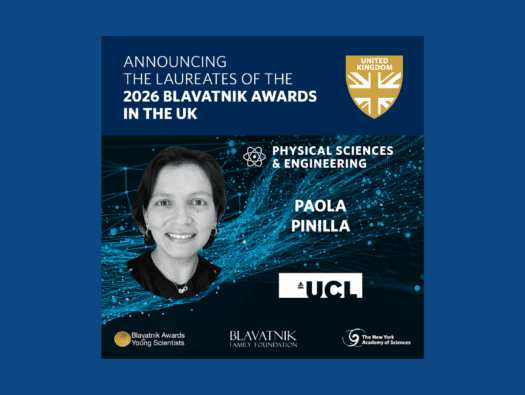
In a recent episode of STEMcast, 2026 Blavatnik Awards for Young Scientists in the UK Laureate Paola Pinilla discusses her research into the earliest stages of planet formation. Pinilla, Associate Professor at University College London, was recognized in Physical Sciences & Engineering for her work showing how pressure differences in discs of gas and dust around young stars can trap particles, allowing them to grow into planets. The conversation introduces listeners to the scientific questions at the center of her work, including how planetary systems form and how water and organic compounds may reach young planets. By translating complex astrophysics into an accessible discussion, the episode highlights both the wonder and rigor of research into the origins of worlds beyond our own. Pinilla’s appearance also reflects the broader public value of the Blavatnik Awards, which recognize exceptional early-career scientists and help bring their discoveries to wider audiences. The episode offers an engaging opportunity to learn more about how planets, including those like Earth, come into being.
Astrophysicist Paz Beniamini Snags Science Prize — a Burst of Light for Reenergizing Open University

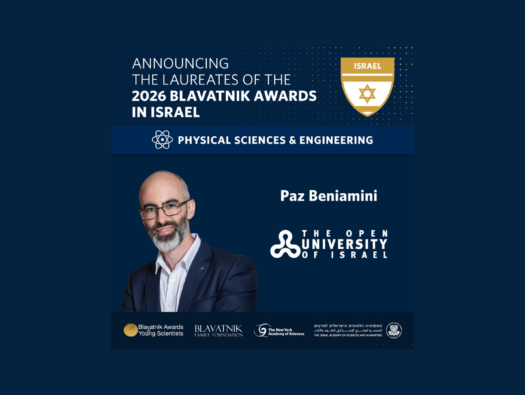
Astrophysicist Paz Beniamini of the Open University of Israel has been named a 2026 Blavatnik Awards for Young Scientists in Israel Laureate in Physical Sciences & Engineering. Beniamini, who leads the university’s Astrophysics Research Center, was recognized for research into extreme cosmic events, including exploding stars, radiation bursts, and rapid collisions. His work combines theoretical physics with observational data, using distant astrophysical phenomena to explore questions that cannot be tested at the same scale on Earth. The recognition marks the first Blavatnik Award for the Open University of Israel, underscoring the growing strength of its focused astrophysics program. It also highlights the importance of supporting outstanding early-career scientists across a broad range of institutions. Through the Awards, the Blavatnik Family Foundation helps advance scientific discovery and recognize researchers whose work expands understanding of the natural world.

Three Young Researchers in Israel Will Receive $100,000 for Groundbreaking Research

The Blavatnik Family Foundation, in collaboration with the Israel National Academy of Sciences and the New York Academy of Sciences, today announced the winners of the Blavatnik Prizes for Young Scientists in Israel for 2026. This is one of the most significant grants awarded to researchers at the beginning of their professional careers, with three scientists selected this year, each of whom leads a different research front - from understanding the molecular mechanisms of serious diseases to deciphering cosmic events occurring in the expanses of space. This year's winners are Dr. Sergey Semenov of the Weizmann Institute of Science, Prof. Uri Ben-David of Tel Aviv University, and Prof. Paz Benyamini of the Open University. Their selection was made by a professional panel of judges who examined 33 candidates from leading academic institutions across the country, with the aim of identifying those whose research has the potential to bring about real change in the world of science and technology.

On Cancer Cell Research, Extreme Cosmic Events and More: The Blavatnik Awards Laureates

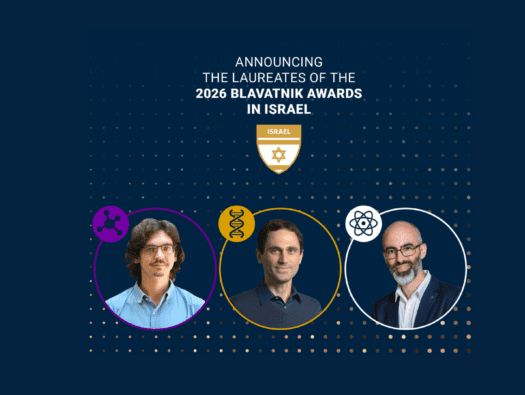
The Blavatnik Family Foundation, the Israel National Academy of Sciences, and the New York Academy of Sciences announced today (Tuesday) the winners of the Blavatnik Prizes for Young Scientists in Israel for 2026. The winners are Dr. Sergey Semenov of the Weizmann Institute, Prof. Uri Ben-David of Tel Aviv University, and Prof. Paz Benyamini of the Open University. Each of the young researchers will receive a grant of $100,000, thanks to their exceptional achievements in three fields – life sciences, chemical sciences, and physical sciences and engineering. This year's awards will be presented at a ceremony expected to take place at the Peres Center for Peace and Innovation in Tel Aviv-Yafo in June 2026.

Announcing the 2026 Laureates of the Blavatnik Awards for Young Scientists in Israel

Sergey N. Semenov, Uri Ben-David, and Paz Beniamini will each be awarded US$100,000 for their groundbreaking scientific research taking place in Israel. The Blavatnik Family Foundation, the Israel Academy of Sciences and Humanities and The New York Academy of Sciences announced today the Laureates of the 2026 Blavatnik Awards for Young Scientists in Israel. Each Laureate will receive US$100,000 in prize money.

UK Visa Rules Have ‘Negative Impact’, Say Prize-Winning Scientists

The 2026 Blavatnik Awards for Young Scientists in the UK recognize exceptional early-career researchers whose work is advancing discovery across the life sciences, chemistry, and the physical sciences and engineering. An article by Research Professional News reflects on both the significance of the Awards and the wider context in which scientific talent develops. Two of the laureates point to visa-related barriers as a continuing challenge for the UK research sector, noting the effect that cost and complexity can have on attracting and retaining outstanding international researchers. Their perspectives underscore the importance of supporting early-career scientists and fostering an environment in which excellence can flourish.

Starmer Must Use Our Scientific Stars to Drive the Economy

In a recent Independent commentary, Chris Blackhurst reflects on the 2026 Blavatnik Awards for Young Scientists at the Banqueting House in Whitehall, describing an evening that highlighted the UK’s strength in early-career research and its potential contribution to national renewal. The piece profiles this year’s three laureates—Maxie Roessler, Thi Hoang Duong (Kelly) Nguyen, and Paola Pinilla—recognized for advances spanning energy transfer in electrons, the biology of DNA replication and chromosome protection, and new insights into how planets begin to form. Blackhurst argues that policymakers should pay closer attention to the scientific talent already thriving in the UK, noting that past awardees have translated discoveries into patents and new ventures, and urging the government to make science and technology central to economic growth.

Colombian Astrophysicist Paola Pinilla Won an Important Award for Young Scientists

aola Pinilla of the University College London is profiled in the Columbian newspaper, El Espectador, which reports that she has been named a 2026 Blavatnik Prize UK laureate in the Physical Sciences and Engineering category. The article highlights her research on planet formation, including the identification of “pressure bumps” in protoplanetary disks—structures that support the early stages of planetary growth. Drawing on telescope observations and computer modelling, her work clarifies where planets form and how water and other essential ingredients are transported within developing planetary systems.

Three Women Named Britain’s Brightest Young Scientists, Each Winning ‘Unrestricted’ £100,000 Blavatnik Awards Prize

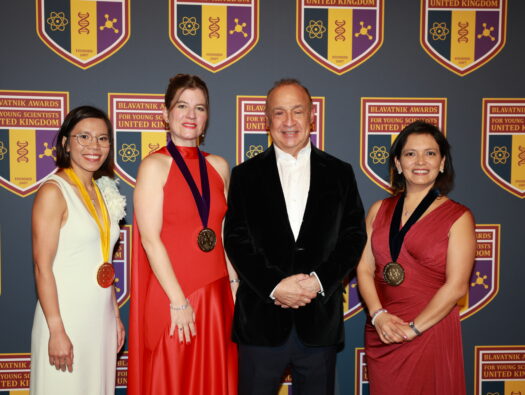
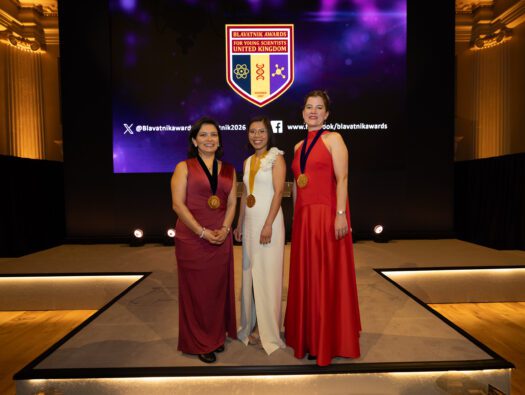
The Blavatnik Family Foundation and The New York Academy of Sciences has announced the three 2026 Laureates of the Blavatnik Awards for Young Scientists in the United Kingdom, who each receive £100,000 – the nation’s largest unrestricted prize for science. The Laureates were announced at a gala dinner and awards ceremony held at the historic Banqueting House in London. The recipients, selected from nine outstanding Finalists, are recognised for exceptional early-career achievements across the Life Sciences, Chemical Sciences, and Physical Sciences & Engineering. The remaining six Finalists are each awarded £30,000 in recognition of their exceptional scientific contributions. It is the second time in the United Kingdom that all three Laureates in the Blavatnik Awards are women scientists.

Women Sweep the Board in UK’s Biggest Science Awards

Three women have been named Britain's "brightest young scientists", each receiving £100,000 – the country's largest unrestricted prize for science. On Tuesday night, Maxie Roessler, Thi Hoang Duong (Kelly) Nguyen, and Paola Pinilla were named the laureates of the 2026 Blavatnik Awards for Young Scientists at a ceremony recognising their advances and innovations in fields including DNA replication, energy transfer in electrons, and planet formation. The awards, now in their ninth year, recognise early‑career breakthroughs with the potential to transform scientific understanding and address global challenges, and are for UK researchers aged under 42. Selected from a pool of 91 nominees across 46 institutions, the three winners were chosen for exceptional achievements in the life sciences, chemical sciences, and physical sciences and engineering. It is only the second time that all three top prizes have been awarded to women – a milestone celebrated at London’s historic Banqueting House, where the ceremony took place.

Learn More

Discover the cutting-edge science we fund

Providing many of the world's best researchers, scientists, and universities with support, and funding to discover breakthroughs that solve humankind's greatest challenges.

See how we support great cultural institutions around the world

The Foundation contributes to renowned institutions that showcase the breadth of arts and culture, including performance, exhibition and education.

Visit the Blavatnik Archive

The Blavatnik Archive is a nonprofit foundation dedicated to preserving and disseminating materials that contribute to the study of 20th-century Jewish and world history, with a special emphasis on World War I, World War II, and Soviet Russia.

Blavatnik Family Foundation
Privacy Overview

This website uses cookies so that we can provide you with the best user experience possible. Cookie information is stored in your browser and performs functions such as recognising you when you return to our website and helping our team to understand which sections of the website you find most interesting and useful.

You can find more information by this link