Skip to content

innovation

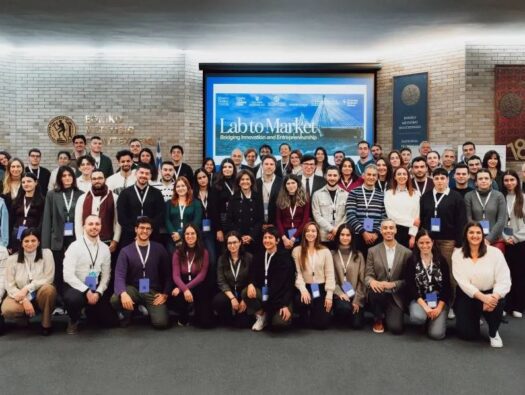
From Greece to New York: Columbia and NTUA Join Forces for Innovation and Entrepreneurship

Columbia University and the National Technical University of Athens have launched Lab to Market: Bridging Innovation and Entrepreneurship, a five-year initiative that supports early-career researchers in translating academic work into viable, globally oriented ventures. Offered free of charge and implemented through the Columbia Global Center Athens, the program combines entrepreneurship education, mentoring and international networks, exposure to New York’s innovation ecosystem, and a competitive business plan pathway focused initially on artificial intelligence, energy and sustainability, and health technologies. With support from the Blavatnik Family Foundation, and in collaboration with partners including Columbia Business School, Endeavor Greece, and the Hellenic Institute for Advanced Studies, the initiative reflects a shared commitment to strengthening links between universities and the market—equipping a diverse cohort of young scientists across Greece with the skills, confidence, and connections needed to turn scientific excellence into meaningful economic and social impact.
Muons: Emblems of discovery

In a Symmetry Magazine article, scientists reflect on the muon—a short-lived cousin of the electron whose unexpected discovery reshaped modern particle physics. Produced when cosmic rays strike Earth’s atmosphere, muons constantly pass through matter, making them powerful tools for both fundamental research and practical applications, from probing the Standard Model to imaging the interiors of large structures. Decades after their discovery, muons continue to test the limits of existing theories and point toward possible new physics. This enduring role as both a puzzle and a probe underscores the kind of foundational inquiry pursued by researchers such as Nathaniel Craig, a 2025 Blavatnik Award National finalist, whose work engages with the open questions that particles like the muon continue to raise.

PFAS, Microplastics and What Comes Next for North Carolina’s Water

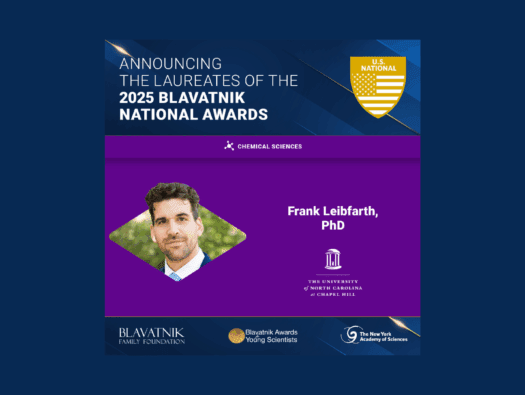
North Carolina is confronting complex water-quality challenges as regulators consider binding limits on per- and polyfluoroalkyl substances (PFAS) and scientists broaden their focus to include microplastics, which increasingly are found alongside PFAS in water and food. As the state’s Environmental Management Commission weighs new rules to reduce these persistent contaminants, researchers are advancing practical treatment solutions for existing systems. Among them is Frank Leibfarth, a 2025 Blavatnik Awards for Young Scientists National laureate whose work on advanced polymer materials and pilot-scale removal technologies aims to capture and destroy PFAS while informing sustainable plastic design—exemplifying the kind of innovation needed to protect public health and water resources in North Carolina.

Q&A: A Blavatnik Fellow’s Journey: Ying Kai Chan on Vision Science, Innovation, and Cirrus Therapeutics

Dr. Ying Kai Chan, a Blavatnik Fellow in Life Science Entrepreneurship at Harvard Business School, reflects on his path from academic immunology to co-founding Cirrus Therapeutics, a biotechnology company focused on developing new treatments for chronic blinding diseases. In a recent HBS interview, he describes how the Fellowship’s combination of scientific rigor, business training, and close mentorship helped him bridge the gap between discovery and application, equipping him to translate vision science into therapies with the potential to improve patients’ lives. Chan highlights the importance of interdisciplinary learning, trusted advisors, and a clear sense of purpose, noting that the Fellowship provided both the skills and the community needed to pursue innovation grounded in real human need.

How Testosterone Fell Out of Favor in Medicine — and How It Came Back

Dr. Abraham Morgentaler, a Blavatnik Faculty Fellow in Health and Longevity at Harvard Medical School, has played a pivotal role in reshaping the contemporary understanding of testosterone therapy. Once shunned over fears it fueled prostate cancer, testosterone treatment has been rehabilitated through decades of Morgentaler’s clinical work and research, which demonstrated its safety and meaningful benefits for men with low testosterone. His pioneering efforts helped overturn long-held misconceptions, leading to broader acceptance of testosterone therapy for appropriate patients and a renewed focus on evidence-based care.

Yale Life Science PitchFest 2025 Breaks Records in Attendance and Awards

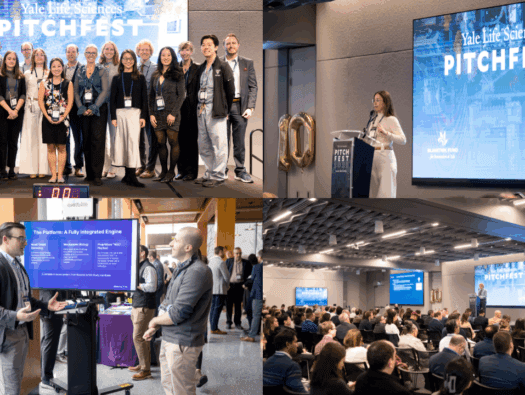
he 2025 Yale Life Science PitchFest showcased Yale’s most promising life science discoveries, from new ways to target tumors to breakthroughs in generative AI and novel biology. Thirty-three faculty-led teams presented new technologies under consideration for the Blavatnik Fund for Innovation at Yale, alongside 16 ePosters from Blavatnik-associated startups that highlighted the region’s accelerating life sciences momentum. The event drew more than 630 attendees—PitchFest’s largest audience to date. “PitchFest and the Blavatnik Fund continue to fuel the translation of Yale life sciences discoveries into real-world impact,” said Morag Grassie, director of the Fund. Over the last decade, the Blavatnik Fund has supported 98 projects and helped launch 47 ventures, collectively raising more than $486 million.

Meet the Presenters: A First Look at the Yale Innovators Announced for the 2025 Yale Life Sciences Pitchfest

Yale Ventures is pleased to announce the 33 Yale faculty members who have been selected to present at the Yale Life Science Pitchfest on Thursday, December 4, 2025. Powered by The Blavatnik Fund for Innovation at Yale, the event will showcase groundbreaking research in therapeutics, medical devices, diagnostics, and digital health, with presenters delivering 5-minute pitches followed by 3-minute Q&A sessions to a panel of judges. The event will take place at 101 College Street in New Haven, CT. The annual event serves as the semifinals for The Blavatnik Fund for Innovation at Yale, an accelerator fund dedicated to advancing the commercialization of applied research and technology in the life sciences. On-the-day cash prizes will total $6,000 and up to an additional $60,000 in in-kind services. Attendees will also have opportunities to meet the presenters directly after each session.

HMS Announces Blavatnik Institute Early Career Investigator Awards

Harvard Medical School has announced 10 recipients of the Blavatnik Institute Early Career Investigator Awards. Totaling $5 million, these grants are designed to fuel high-potential research conducted by some of the most exceptional junior faculty members — those within the first decade of their careers as principal investigators — on the HMS Quadrangle. The awards were made possible by ongoing support from the Blavatnik Family Foundation that aims to spur scientific advancement and transform those discoveries into new therapies and new tools to diagnose, prevent, and treat disease. “Thanks to the generosity of Len Blavatnik and the Blavatnik Family Foundation, we are enabling extraordinarily promising science at the most vulnerable stage in young investigators’ careers,” said HMS Dean George Q. Daley.

Celebrating Scientific Excellence at the 2025 Blavatnik Awards for Young Scientists Ceremony

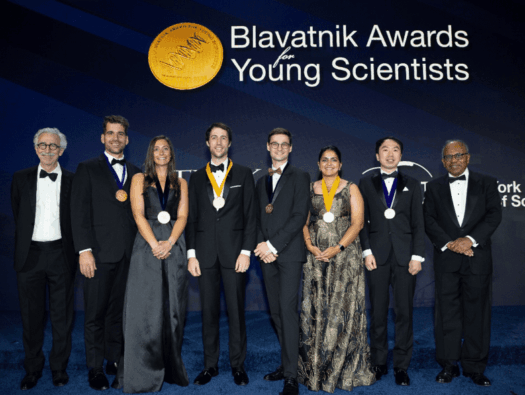
The American Museum of Natural History provided a stunning backdrop for the 2025 Blavatnik Awards for Young Scientists ceremony, held on October 7, 2025 where exceptional early-career researchers were honored with the nation’s largest unrestricted prize for young scientists. The event was hosted by the Blavatnik Family Foundation and The New York Academy of Sciences. Nicholas Dirks, President and CEO of The New York Academy of Sciences, highlighted the remarkable growth and impact of the awards program since its inception in 2007. “Now in their nineteenth year, the Blavatnik Awards have distinguished themselves as one of the world’s most prestigious international prizes in the scientific community, dedicated to advancing groundbreaking research and supporting exceptional talent,” Dirks explained. He emphasized the program’s success: “Since its inception, the awards have recognized over 500 honorees from 120 research institutions.” Dirks also spoke about the Award’s impressive economic impact, noting that Blavatnik Scholars have founded over 50 companies, raised 2.4 billion dollars in capital, and secured over 7,300 patents worldwide.

An AI System with Detailed Diagnostic Reasoning Makes Its Case

Researchers at Harvard Medical School are developing Dr. CaBot as a medical education tool. The system, which operates in both presentation and written formats, shows how it reasons through a case, offering what’s called a differential diagnosis — a comprehensive list of possible conditions that explain what’s going on — and narrowing down the possibilities until it reaches a final diagnosis. Dr. CaBot’s ability to spell out its “thought process” rather than focusing solely on reaching an accurate answer distinguishes it from other AI diagnostic tools. It is also one of only a few models designed to tackle more complex medical cases. “We wanted to create an AI system that could generate a differential diagnosis and explain its detailed, nuanced reasoning at the level of an expert diagnostician,” said Arjun (Raj) Manrai, assistant professor of biomedical informatics in the Blavatnik Institute at HMS. Manrai created Dr. CaBot with Thomas Buckley, a Harvard Kenneth C. Griffin School of Arts and Sciences doctoral student and a member of the Manrai lab.

Learn More

Discover the cutting-edge science we fund

Providing many of the world's best researchers, scientists, and universities with support, and funding to discover breakthroughs that solve humankind's greatest challenges.

See how we support great cultural institutions around the world

The Foundation contributes to renowned institutions that showcase the breadth of arts and culture, including performance, exhibition and education.

Visit the Blavatnik Archive

The Blavatnik Archive is a nonprofit foundation dedicated to preserving and disseminating materials that contribute to the study of 20th-century Jewish and world history, with a special emphasis on World War I, World War II, and Soviet Russia.

Blavatnik Family Foundation
Privacy Overview

This website uses cookies so that we can provide you with the best user experience possible. Cookie information is stored in your browser and performs functions such as recognising you when you return to our website and helping our team to understand which sections of the website you find most interesting and useful.

You can find more information by this link